
GST Calculator Tips for Small Businesses in India 2026
MoneyUtility Team
Tax & Financial Consultant
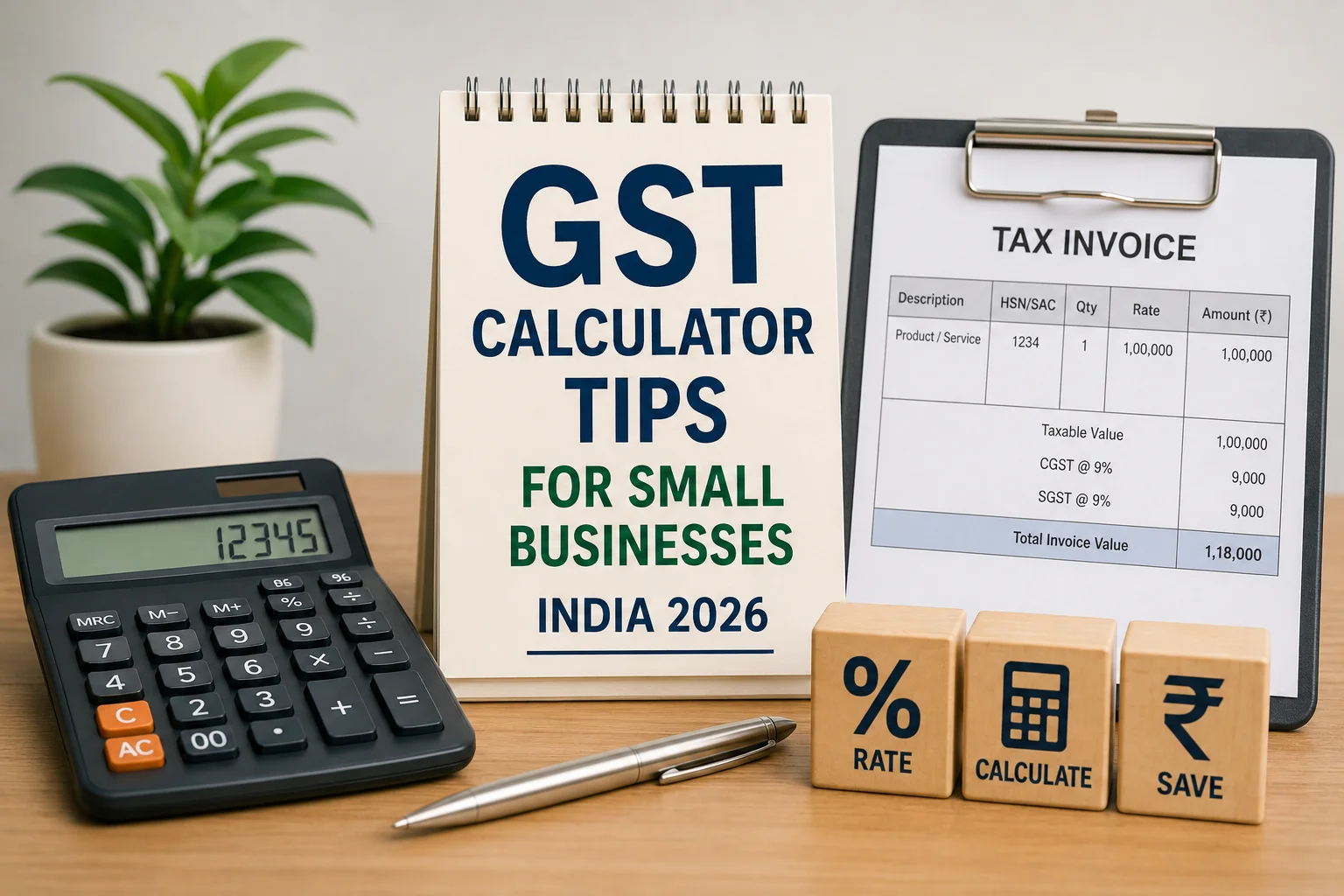
For any entrepreneur looking to manage tax compliance seamlessly, using the right GST calculator tips small business India offers is the first line of defense against costly billing errors. Adding GST incorrectly on your outgoing bills is more common than you think, often leading to immediate notices from the tax department. Whether you are running a local retail shop, offering freelance services, or managing inter-state distribution, understanding the math behind tax rates is critical to keeping your margins intact.
Table of Contents
1. Getting GST Wrong on Your Invoices Can Trigger a Notice — Here's How to Avoid It
Let's look at a concrete real-world comparison to show why accurate math is so important to the tax department. Suppose a small trader in Surat sells a batch of textiles. If the trader bills the client for a base price of ₹1,00,000 plus 18% GST, the client is charged ₹1,00,000 + ₹18,000 = ₹1,18,000. This is a simple GST-exclusive bill where the base value and tax are completely clear.
Now, imagine another business owner who quotes a lump-sum price of ₹1,18,000 inclusive of GST to their client. If this seller mistakenly calculates the tax by multiplying the total amount by the tax rate directly (₹1,18,000 × 18% = ₹21,240), they are reporting a completely wrong tax liability. The tax department expects the actual tax to be calculated on the base price, which is ₹18,000 (resulting in a base price of ₹1,00,000).
This arithmetic error creates a mismatch of ₹3,240 (₹21,240 vs ₹18,000). If the seller files their GSTR-1 or GSTR-3B using the wrong base amount, the discrepancy will trigger a system-generated warning or an audit notice from the GST Network (GSTN). Incorrect calculations either lead to paying excess tax out of your own pocket or under-reporting tax liabilities, which invites penalties and blocks your customer's Input Tax Credit (ITC). To safeguard your cash flow, you must calculate tax amounts correctly on every invoice.
2. GST Basics: The Three Types of GST You Must Know
Before calculating taxes, small businesses must identify which components of GST apply to their sales. Depending on whether the transaction occurs within the same state (intrastate) or across state boundaries (interstate), the tax will be split into CGST, SGST, or charged as IGST.
| GST Type | Full Form | When Applied | Goes To |
|---|---|---|---|
| CGST | Central Goods and Services Tax | Intrastate sales (within the same state) | Central Government |
| SGST | State Goods and Services Tax | Intrastate sales (within the same state) | State Government |
| IGST | Integrated Goods and Services Tax | Interstate sales (across state borders) | Central Government (shared with consumer state) |
Let's look at how this applies to a transaction. Suppose a trader makes an intrastate sale of goods valued at ₹1,00,000 to a buyer in the same state under the 18% tax rate. The tax amount of ₹18,000 is split equally: the seller must charge 9% CGST (₹9,000) and 9% SGST (₹9,000) on the tax invoice.
If the same trader makes an interstate sale of the same goods worth ₹1,00,000 to a buyer in another state, the seller charges a single rate of 18% IGST (₹18,000) on the invoice. Choosing the wrong type of GST is a frequent error. If you mistakenly collect CGST and SGST on an interstate transaction, you cannot adjust it against your IGST liability; you must pay the IGST separately and claim a refund for the wrongly paid CGST/SGST.
3. How to Add GST to a Price (GST-Exclusive Calculation)
The most common scenario for business pricing is the GST-exclusive calculation. Here, you have a set base price for your product or service and you need to add the tax on top to determine the final amount your customer must pay. Master how to calculate GST in India using these standard formulas:
GST Amount = Base Price × (GST Rate ÷ 100)
Total Invoice Amount = Base Price + GST Amount
| Base Price (₹) | GST Rate | GST Amount (₹) | Total Invoice Amount (₹) |
|---|---|---|---|
| ₹500 | 5% | ₹25 | ₹525 |
| ₹1,000 | 12% | ₹120 | ₹1,120 |
| ₹5,000 | 18% | ₹900 | ₹5,900 |
| ₹10,000 | 28% | ₹2,800 | ₹12,800 |
For instance, if you are selling a software subscription with a base price of ₹5,000 at a rate of 18% GST, your calculation is:
GST Amount = ₹5,000 × (18 ÷ 100) = ₹900
Total Invoice Amount = ₹5,000 + ₹900 = ₹5,900.
If you want to perform these calculations instantly without doing the math manually, you can use our free online GST Calculator to get instant breakdowns of the tax split for CGST, SGST, and IGST components.
4. How to Remove GST from an Inclusive Price (Reverse GST Calculation)
When you sell products at a flat, all-inclusive price, you need to work backward to separate the base price from the tax. This process is crucial to ensure you report the correct taxable value on the GSTN portal. To achieve this, you must understand the math of a GST inclusive vs exclusive calculation.
Use the following formulas for reverse GST calculation:
Base Price = Inclusive Price ÷ (1 + GST Rate ÷ 100)
GST Amount = Inclusive Price − Base Price
| Inclusive Price (₹) | GST Rate | Base Price (₹) | GST Amount (₹) |
|---|---|---|---|
| ₹525 | 5% | ₹500 | ₹25 |
| ₹1,120 | 12% | ₹1,000 | ₹120 |
| ₹5,900 | 18% | ₹5,000 | ₹900 |
| ₹12,800 | 28% | ₹10,000 | ₹2,800 |
⚠️ Watch Out: Multiplying the final inclusive price directly by the GST rate is the single most common reverse calculation error made by small businesses. Doing so will output an incorrect tax figure.
For example, if you sell a handicraft item for a flat ₹1,120 inclusive of 12% GST:
- Incorrect Method: ₹1,120 × 12% = ₹134.40.
- Correct Method: Base Price = ₹1,120 ÷ 1.12 = ₹1,000; Tax Amount = ₹1,120 − ₹1,000 = ₹120.
The incorrect method over-reports your tax by ₹14.40, directly eating into your profit margin.
5. GST Rate Finder: Which Rate Applies to Your Product or Service?
India's GST architecture divides taxable items across five primary rate slabs. Correctly identifying your product or service slab prevents audit disputes and ensures your billing is compliant.
| Rate Slab | Common Products/Services (Indian Market Examples) |
|---|---|
| 0% | Fresh fruits and vegetables, fresh milk, unbranded rice/wheat, salt, newspapers, books, and basic public health services. |
| 5% | Packaged food items (branded paneer, flour), tea, coffee, edible vegetable oil, domestic LPG, cashew nuts, and footwear below ₹1,000. |
| 12% | Butter, cheese, ghee, processed dry fruits, mobile phones, work contracts, notebooks, and business-class air travel tickets. |
| 18% | Software services, IT consultancy, telecommunication services, professional accounting, dining at restaurants, capital machinery, and soaps. |
| 28% | Luxury passenger vehicles, aerated soft drinks, tobacco products, cement, air conditioners, dishwashers, and entry to theme parks. |
To classify your items, you must use the official GSTN directory. Physical goods are categorized using HSN (Harmonised System of Nomenclature) codes, whereas services are classified under SAC (Services Accounting Code) codes. You can search these using an online HSN SAC code finder India to locate the precise code that must be printed on your tax invoices.
💡 Tip: The length of the HSN code you are required to use depends directly on your annual turnover. Under GST rules:
- Businesses with an aggregate turnover up to ₹5 crore in the previous financial year must use at least a 4-digit HSN code on B2B invoices.
- Businesses with a turnover exceeding ₹5 crore must print the full 8-digit HSN code on all invoices.
6. Building a GST-Compliant Invoice: What Must Be Included
Issuing a correct tax invoice is the core compliance requirement under the GST law. Missing any mandatory details will not only invite penalties during tax audits but also lead to your buyer's Input Tax Credit (ITC) claim being rejected. Keep your billing compliant with a standardized GST invoice format India 2026.
According to GST rules, a tax invoice must contain the following 12 mandatory fields:
- GSTIN of supplier — Your business's 15-digit Goods and Services Tax Identification Number.
- Invoice number — A consecutive, unique serial number containing only alphabets, numbers, or special characters, not exceeding 16 characters.
- Date — The date on which the invoice is generated and issued.
- Recipient name + GSTIN — The registered billing name, address, and GSTIN of your business client.
- Place of supply — The name of the state where the goods are delivered or services are consumed.
- HSN/SAC code — The classification code (4-digit or 8-digit) for each item on the invoice.
- Description of goods/services — A clear, readable description of the products or services supplied.
- Quantity + unit — The quantity and physical unit of measure (e.g., kilograms, numbers, meters) of the goods.
- Value before tax — The total taxable value of the goods or services before adding GST.
- GST rate — The specific percentage bracket (e.g. 5%, 18%) applied to each line item.
- CGST/SGST or IGST amount — The exact tax calculation split printed clearly as separate columns.
- Total invoice value — The final invoice amount payable by the customer, inclusive of all tax additions.
⚠️ Watch Out: If you issue invoices that lack correct HSN codes, correct place of supply details, or fail to split CGST/SGST on local bills, the GST portal will not match your buyer's purchase data. This causes their ITC to be blocked. To design, build, and download compliant invoices instantly, use our free online Invoice Builder.
7. Reverse Charge Mechanism: When You Pay GST on Purchases
In normal business transactions, the supplier calculates the GST, collects it from the buyer, and pays it to the government. However, under the reverse charge mechanism GST India rules, the process is completely inverted for specific purchases.
Under RCM, the liability to calculate and pay tax shifts from the seller to the buyer. The buyer must pay the GST directly to the government via their electronic cash ledger. RCM applies in these specific cases:
- Purchasing goods or services from an unregistered supplier (if you are a registered business, under specific product notifications).
- Availing legal services from an advocate or law firm.
- Hiring services from a Goods Transport Agency (GTA).
- Importing services from a supplier located outside India.
Let's look at a worked example. Suppose a registered corporate business hires an unregistered freelance designer for a branding project and pays them ₹50,000. Because the freelancer is unregistered, they cannot charge GST on their invoice. Under RCM rules, the corporate business must calculate the applicable tax (18% for design services) and pay 18% GST = ₹9,000 directly to the government.
💡 Tip: You can claim the GST paid under RCM as Input Tax Credit (ITC) in the same filing period. However, you must pay the tax in cash through GSTR-3B first, issue a self-invoice for the transaction, and only then claim the equivalent credit to offset your future tax liability.
8. Common GST Calculation Mistakes Small Businesses Make
Billing errors can trigger expensive tax notices, audits, and interest penalties. Review this list of the six most common GST calculation mistakes small businesses make so you can avoid them:
- Charging GST on GST-exempt items: Levying taxes on essential goods like unbranded food grains, books, or fresh milk. Doing this is illegal and forces your buyers to pay extra.
- Using the wrong GST rate slab: Billing products at 12% instead of 18% due to outdated product classification. The tax department will demand the shortfall along with 18% annual interest.
- Not separating CGST and SGST on local sales: Printing a single 18% IGST amount on an invoice when the buyer is inside your own state, which violates the tax filing structure.
- Calculating reverse GST using the wrong formula: Determining the base price by multiplying an inclusive amount by the tax percentage directly (e.g. ₹1,180 × 18% = ₹212.40) instead of dividing by 1.18.
- Forgetting to charge GST on freight charges: If you charge your customer for shipping or packing (e.g., ₹1,000 shipping on a ₹10,000 product), you must add GST to the shipping fee at the same rate as the main product.
- Not updating HSN codes based on turnover: Failing to switch from 4-digit to 8-digit HSN codes on B2B invoices once your annual turnover crosses the mandatory ₹5 crore limit.
9. Using MoneyUtility's Free GST Calculator: GST Calculator Tips for Small Business India
Applying these gst calculator tips small business India guidelines manually on every single bill can take hours and lead to arithmetic mistakes. To simplify your workflow, MoneyUtility offers a free, high-speed online GST Calculator designed specifically for Indian entrepreneurs, traders, and freelancers.
Here's how to use the tool in three simple steps:
- Choose the calculation mode: Select the "Add GST" button for exclusive pricing, or the "Remove GST" button to reverse-calculate inclusive pricing.
- Enter your amounts: Key in the base price or the total inclusive invoice value in rupees (₹).
- Select the tax slab: Click on the applicable rate button (5%, 12%, 18%, or 28%).
The tool instantly displays the exact base price, the total tax amount, and provides a clear breakdown of the CGST, SGST, and IGST portions. There is no login or registration required, it provides instant results, and you can share the calculated figures via a link. For more detailed instructions on registration thresholds and filing rules, you can also consult our comprehensive GST small business guide.
10. GST Calculation Quick Reference Card
Save this handy cheat sheet table to quickly double-check your manual calculations or set up billing formulas in your accounting spreadsheet software:
| Task | Formula | Worked Example |
|---|---|---|
| Add GST | Base × (1 + rate/100) | ₹1,000 + 18% = ₹1,180 |
| Remove GST | Inclusive ÷ (1 + rate/100) | ₹1,180 ÷ 1.18 = ₹1,000 |
| Find GST amount (exclusive) | Base × rate/100 | ₹1,000 × 0.18 = ₹180 |
| Find GST amount (inclusive) | Inclusive × rate/(100+rate) | ₹1,180 × 18/118 = ₹180 |
| CGST + SGST split | GST amount ÷ 2 each | ₹180 → ₹90 CGST + ₹90 SGST |
11. Frequently Asked Questions About GST Calculation
How do you calculate 18% GST on a price?
To calculate 18% GST, multiply the base price by 0.18. For example, if your base product price is ₹1,000, the GST amount is ₹1,000 × 0.18 = ₹180. The total invoice price is ₹1,000 + ₹180 = ₹1,180.
How to reverse calculate GST from a total amount?
To reverse calculate GST, divide the total inclusive amount by (1 + GST Rate ÷ 100). For example, if you want to reverse calculate an 18% tax rate from a total of ₹1,180, your base price is ₹1,180 ÷ 1.18 = ₹1,000, and the GST amount is ₹1,180 − ₹1,000 = ₹180.
What is the difference between CGST, SGST and IGST?
CGST (Central GST) and SGST (State GST) are levied on transactions within the same state (intrastate) and split equally between the Central and State governments. IGST (Integrated GST) is charged on transactions between different states (interstate) and collected by the Central government.
Which items are exempt from GST in India?
Essential items such as fresh milk, curd, fresh fruits and vegetables, unbranded food grains, flour, salt, newspapers, books, and basic public health or education services are exempt from GST in India, carrying a tax rate of 0%.
How to find the HSN code for my product?
You can search for HSN and SAC codes directly on the official GSTN portal or use a online HSN SAC code finder India tool. Ensure you use a 4-digit HSN code if your turnover is under ₹5 crore, and an 8-digit code if it is above.
12. Conclusion
Applying these GST calculator tips small business India guidelines will save your business from costly errors and keep your accounting compliant. By using the correct formulas, verifying HSN codes, and avoiding common billing pitfalls, you protect your business from tax notices and maintain smooth trade relations. Keep your business running efficiently by calculating your tax splits correctly on every single transaction.