
Home Loan vs Rent: Which is the Better Financial Decision in India 2026?
MoneyUtility Team
Personal Finance Expert
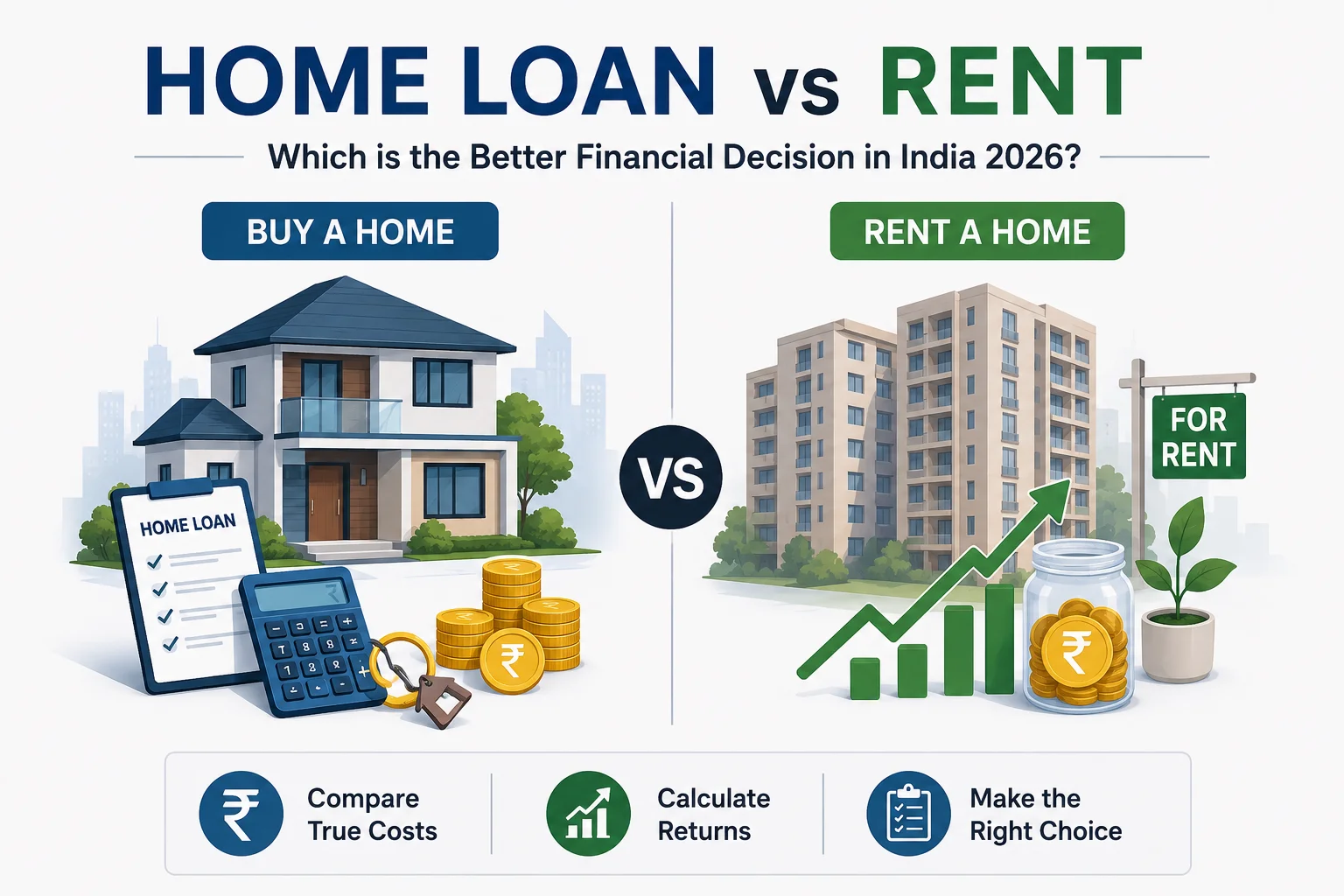
When a professional hits 30 in a Tier-1 Indian city, one question inevitably dominates late-night family discussions: is it wiser to rent or take a home loan? Deciding between a home loan vs rent India is not just a lifestyle choice, but one of the most critical financial milestones you will face in 2026. In a market characterized by sky-high property prices, low rental yields, and fluctuating interest rates, making the wrong choice can set your net wealth back by crores of rupees.
To understand this debate objectively, we will analyze the numbers for a 30-year-old corporate worker with a budget of ₹80 Lakh for a residential flat in a Tier-1 Indian city. We will contrast Option A: buying the flat with a ₹20 Lakh down payment and a ₹60 Lakh home loan at 8.75% interest rate over 20 years.
We compare this against Option B: renting the exact same flat for ₹25,000 per month and systematically investing the down payment and monthly savings difference into an equity SIP portfolio. By applying mathematical rigor to property appreciation, rental inflation, tax benefits, and investment opportunity costs, we will help you make a fully informed financial decision.
Table of Contents
1. The ₹80 Lakh Question Every Indian Asks at 30
For a 30-year-old professional living in a Tier-1 Indian city like Mumbai, Bangalore, or Pune, renting a comfortable flat is usually an easy default. But as marriage, family planning, and peer pressure set in, the emotional urge to acquire physical property grows rapidly. You find yourself at a fork in the road:
- Option A: Purchase an ₹80,00,000 ready-to-move-in flat. You pull ₹20,00,000 from your savings for the down payment and finance the remaining ₹60,00,000 through an SBI home loan at 8.75% interest rate over a 20-year tenure.
- Option B: Rent the exact same flat for ₹25,000 per month. You keep the ₹20,00,000 cash invested in diversified equities, and each month, you invest the difference between the buyer's monthly cost and your rent into a mutual fund SIP.
To evaluate which option leads to greater long-term wealth, we must look beyond emotional validation. We must address whether is buying a house better than renting India from a pure cash-flow and opportunity-cost standpoint. By comparing the actual out-of-pocket costs of ownership against renting over a 20-year horizon, we can identify which path leaves you in a superior net wealth position.
2. The True Cost of Buying a Home (Beyond the EMI)
Many buyers assume that homeownership simply means paying the down payment and then the monthly bank EMI. However, buying a house involves substantial upfront and recurring costs that are often left out of standard calculations. These auxiliary expenses can inflate the overall acquisition cost of a ₹80,00,000 property by lakhs of rupees.
| Cost Item | Amount (₹) | One-Time or Recurring? |
|---|---|---|
| Down Payment (25% of property value) | ₹20,00,000 | One-Time |
| Stamp Duty & Registration Fee (~6%) | ₹4,80,000 | One-Time |
| GST (5% if under-construction) | ₹4,00,000 | One-Time |
| Home Loan Processing Fee | ₹15,000 | One-Time |
| Interiors, Woodwork & Renovation | ₹8,00,000 | One-Time |
| Monthly Home Loan EMI (8.75% for 20 yrs) | ₹53,023 / month | Recurring (Monthly) |
| Annual Maintenance (0.6% of property value) | ₹48,000 / year (₹4,000/mo) | Recurring (Annual) |
| Property Tax | ₹12,000 / year (₹1,000/mo) | Recurring (Annual) |
| Society / Security Charges | ₹24,000 / year (₹2,000/mo) | Recurring (Annual) |
| Home Structure & Content Insurance | ₹8,000 / year (₹667/mo) | Recurring (Annual) |
| Total 20-Year Cost (Actual Outflow) | ₹1,82,60,434 | Sum of one-time + recurring |
When we add up the ₹20,00,000 down payment, ₹16,95,000 in registration, taxes, interiors, and fees, along with 20 years of home loan EMIs totaling ₹1,27,25,434, and cumulative maintenance, insurance, and taxes totaling ₹18,40,000, the actual cash outflow for buying the house comes to ₹1,82,60,434 (approx. **₹1.83 Crores**). Paying interest of ₹67,25,434 on a principal of ₹60,00,000 represents a major portion of the cost. To understand the long-term impact of interest on your budget, you can review our loan tenure impact guide. Additionally, substantial tax deductions on principal and interest can offset these borrowing costs; explore our guide on home loan tax benefits for 2026.
3. The True Cost of Renting (Beyond the Monthly Rent)
Renting a flat is often described as "throwing money away," but this perspective overlooks the flexibility and cash flow benefits it offers. Just like buying, renting involves costs beyond the initial monthly rent. In Indian metro cities, tenants face annual lease hikes, brokerage fees, security deposits, and relocation costs that compound over 20 years.
| Cost Item | Amount (₹) / Rate | One-Time or Recurring? |
|---|---|---|
| Initial Monthly Rent | ₹25,000 / month | Recurring (Monthly) |
| Annual Rent Increase | 6% per year | Recurring (Annual escalation) |
| Security Deposit (4 Months Rent) | ₹1,00,000 | One-Time (Refundable) |
| Brokerage Fee (1 Month Rent per move) | ₹1,74,738 (Cumulative over 4 moves) | Recurring (Every 4 years) |
| Packers, Movers & Relocation Costs | ₹60,000 (₹15,000 per move) | Recurring (Every 4 years) |
| Total 20-Year Cost (Actual Outflow) | ₹1,13,70,415 | Sum of rent, moves, fees, deposit |
In Indian cities, lease agreements typically demand a 5% to 7% annual increase. Assuming a standard 6% annual hike, your initial rent of ₹25,000 grows to ₹44,772 by Year 10 and reaches ₹75,640 by Year 20. Over 20 years, your cumulative rent payment reaches ₹1,10,35,677. Adding brokerage, shifting fees (assuming you move every 4 years due to owner negotiations or job shifts), and the initial ₹1,00,000 deposit (returned at the end), the total 20-year cost of renting is ₹1,13,70,415.
4. Side-by-Side Financial Comparison Over 20 Years: Home Loan vs Rent India
To make a fair comparison between these two paths, we must look at the cash outflows and compare the assets created at the end of 20 years. The renter has a lower monthly layout in the early years compared to the buyer's fixed EMI and maintenance costs. By investing the initial down payment difference (₹35,95,000) and the monthly savings difference into an equity SIP, the renter can build a substantial corpus.
| Financial Metric | Buying (Option A) | Renting + Investing (Option B) |
|---|---|---|
| Total Cash Outflow (20 Years) | ₹1,82,60,434 | ₹1,13,70,415 |
| End Asset Value (Year 20) | Property Value: ₹2,12,26,382 (5% CAGR) | SIP Corpus: ₹5,60,48,863 (12% CAGR) |
| Home Loan Tax Savings (Old Regime) | + ₹19,60,302 (30% slab) | ₹0 (HRA savings are separate) |
| Net Wealth Position | ₹49,26,249 | ₹4,47,78,448 |
This comparison shows that a renter who invests their surplus capital can build a larger wealth reserve. This is due to the compounding effect of the ₹35,95,000 initial capital difference (saved by avoiding the down payment, stamp duty, interiors, and GST), along with the monthly savings difference between the EMI plus maintenance (₹60,690) and the initial rent (₹25,000). To design your own savings plans, you can use our SIP Calculator to adjust rates and horizons.
5. The Opportunity Cost Angle: Your Down Payment as an Investment
The concept of opportunity cost is central to this choice. The money you put toward a down payment and transaction costs is capital that cannot be invested elsewhere. This is the opportunity cost of buying a house India. By locking up ₹20,00,000 in real estate, you miss out on potential returns from other asset classes like equity mutual funds, which historically track the Nifty 50 at a 12% CAGR.
Let's evaluate the performance of these two options over 20 years:
- Option A (Real Estate): The ₹20,00,000 down payment grows inside the house value. At a typical residential appreciation rate of 5% CAGR, this portion of the property equity grows to ₹53,06,595 in 20 years.
- Option B (Equity Mutual Funds): If you invest the same ₹20,00,000 in an equity fund returning 12% CAGR, it grows to ₹1,92,92,586 (approx. **₹1.93 Crores**) in 20 years.
The difference represents an opportunity cost of ₹1,39,85,991 (nearly **₹1.40 Crores**) on your down payment alone. While real estate provides a physical home, it can also limit the growth of your liquid capital. Comparing the long-term potential of property investment vs renting highlights how equity-backed investments can outpace average residential real estate growth in India.
6. Home Loan Tax Benefits: The Often-Overlooked Buying Advantage
One of the main financial incentives for buying a home is the set of tax deductions available under the Old Tax Regime. The Indian government offers tax breaks on both the interest and principal components of a home loan:
- Section 24(b): Deduct up to ₹2,00,000 per year on the interest paid for a self-occupied property.
- Section 80C: Deduct up to ₹1,50,000 per year on the principal repayment of the loan (subject to the overall Section 80C limit of ₹1.5L, which also includes PPF, ELSS, and EPF).
- Section 80EEA: An additional interest deduction of up to ₹1,50,000 was available for first-time home buyers of affordable housing (property value up to ₹45L, loan sanctioned by March 2022). For our ₹80L flat in 2026, this additional deduction does not apply.
For a buyer in the 30% tax slab, maximizing these deductions can save up to ₹1,05,000 per year in taxes. Over the 20-year loan tenure, this tax relief adds up to a cumulative savings of ₹19,60,302, which helps offset some of the interest costs. To calculate your potential monthly payments, you can use our Home Loan Calculator.
7. Property Appreciation: Is It Really 10–15% Per Year?
Many people expect double-digit annual appreciation from real estate, often citing historic gains from the early 2000s. However, residential property returns have moderated, and long-term data shows that residential real estate in major cities often delivers low single-digit inflation-adjusted returns.
Let's look at the average residential CAGR over the past decade:
- Mumbai Metro Residential: 4% to 7% CAGR. With inflation averaging 5%, the real, inflation-adjusted returns are often close to 0% to 2%.
- Bangalore IT Corridor: 6% to 9% CAGR. Tech hubs see higher demand, but these returns are localized to specific high-growth areas.
- Tier-2 Cities: 3% to 5% CAGR. Overbuilt micro-markets and slow infrastructure development can limit appreciation.
While commercial real estate can yield higher returns, residential property appreciation in India often tracks close to inflation. If you buy a property with the expectation that its value will double every 5 years, you may end up disappointed.
8. Non-Financial Factors That Matter
The home loan vs rent India debate is not decided solely by math. Non-financial aspects, such as lifestyle preferences, career goals, and emotional needs, play a major role in the decision.
The Case for Buying (Stability & Security):
- Emotional Peace of Mind: Owning a home provides a sense of permanent stability for your family.
- No Landlord Risk: You don't have to worry about sudden lease terminations or landlord visits.
- Freedom to Customize: You can renovate and design the space to suit your personal tastes.
- Forced Saving: The commitment to a monthly home loan EMI acts as a disciplined savings mechanism for those who struggle to invest.
The Case for Renting (Flexibility & Liquidity):
- Career Mobility: Renting allows you to relocate easily for new job opportunities without being tied down by a property.
- Zero Maintenance Stress: Major repairs, property taxes, and society disputes remain the owner's responsibility.
- Capital Liquidity: Your savings are kept in liquid assets like mutual funds rather than being locked in a property.
- Lifestyle Adaptability: You can choose to live closer to your workplace or your children's school as your needs change.
9. Who Should Buy and Who Should Rent? (Decision Framework)
To simplify your choice, we have put together a decision framework. If you are comparing options, you can use our EMI Calculator to test different loan values.
Buy if:
- You plan to live in the same city for at least 10+ years.
- Your monthly home loan EMI is less than 40% of your household take-home income.
- You have a stable career with predictable income growth.
- You have a strong credit score (above 750) to secure favorable interest rates.
- You have established family plans and value long-term stability.
- You can cover the down payment and registration costs without using your emergency funds.
Rent if:
- Your career requires high mobility, or you plan to relocate in the next 3 to 5 years.
- You live in a high-priced metro where the price-to-rent ratio is high.
- You are in the early stages of your career with potential changes in income.
- You can generate higher returns (12%+) by investing your capital in equities.
- The local real estate market is at a peak, with low rental yields.
- You prefer to avoid long-term debt and want to maintain financial liquidity.
10. The Price-to-Rent Ratio: A Quick Market Health Check
The Price-to-Rent (P/R) ratio is a simple tool used to evaluate the financial dynamics of a local housing market. It is calculated as follows:
Here is how to interpret the ratio:
- P/R Ratio under 15: Buying is generally more cost-effective than renting.
- P/R Ratio between 15 and 20: Neutral zone (the decision depends on personal preferences and interest rates).
- P/R Ratio above 20: Renting is typically the more financially efficient choice.
Let's look at the P/R ratios for our ₹80 Lakh flat across three Indian cities with different typical rental levels in 2026:
- Mumbai Suburbs (Monthly Rent: ₹32,000):
Annual Rent = ₹3,84,000. P/R Ratio = ₹80,00,000 ÷ ₹3,84,000 = 20.8.
Interpretation: Renting is the more financially efficient choice. - Bangalore Tech Corridor (Monthly Rent: ₹28,000):
Annual Rent = ₹3,36,000. P/R Ratio = ₹80,00,000 ÷ ₹3,36,000 = 23.8.
Interpretation: Renting is the more financially efficient choice. - Hyderabad Suburbs (Monthly Rent: ₹24,000):
Annual Rent = ₹2,88,000. P/R Ratio = ₹80,00,000 ÷ ₹2,88,000 = 27.7.
Interpretation: Renting is much more financially efficient.
The high P/R ratios in major Indian cities indicate that rental yields (annual rent divided by property price) are low, often around 2% to 3.5%. In contrast, home loan interest rates are much higher, typically around 8.5% to 9.5%. This gap explains why renting can be a viable financial option in these markets.
11. Frequently Asked Questions: Home Loan vs Rent
Is it better to buy or rent a house in India in 2026?
The choice depends on your financial goals, career stage, and location. Renting can be a practical option in cities with low rental yields and high price-to-rent ratios, provided you invest your savings. Buying may be suitable if you plan to stay in one place long-term and value the security of owning your home.
How much should your EMI be as a percentage of income?
As a general rule, your home loan EMI should not exceed 35% to 40% of your monthly net take-home income. Keeping payments within this range helps ensure you have enough cash flow to cover daily expenses, maintain an emergency fund, and continue saving for other long-term goals.
What is the price-to-rent ratio in Indian cities?
In Indian metro cities, the price-to-rent ratio often ranges from 22 to 30. This high ratio is driven by low rental yields (typically 2% to 3%) relative to property sale prices, which makes renting a financially viable option in these areas.
Can renting be a better investment than buying property?
Renting is not an investment in itself, but the savings it allows can be. If you rent and invest the difference—including the down payment and monthly savings—into assets like equity mutual funds, the potential returns can outpace typical residential real estate growth.
Is now a good time to buy a house in India?
A good time to buy depends more on your personal financial readiness than on market timing. If you have stable income, plan to stay in the home long-term, and can secure a competitive loan rate, buying may make sense. However, if property prices in your area are high and rental yields are low, renting while building your investments can be a reasonable alternative.
12. Conclusion
Deciding between a home loan vs rent India is a personal decision that involves both financial calculations and lifestyle choices. While renting can offer flexibility and potential investment growth, buying a home provides long-term stability and a physical asset. Ultimately, the right choice depends on your career stage, mobility needs, and financial discipline. If you decide to buy, choosing a suitable loan tenure and interest rate is key to managing your long-term costs.