
SIP vs Lumpsum Investment: Which Strategy Wins in 2026?
MoneyUtility Team
Personal Finance Expert
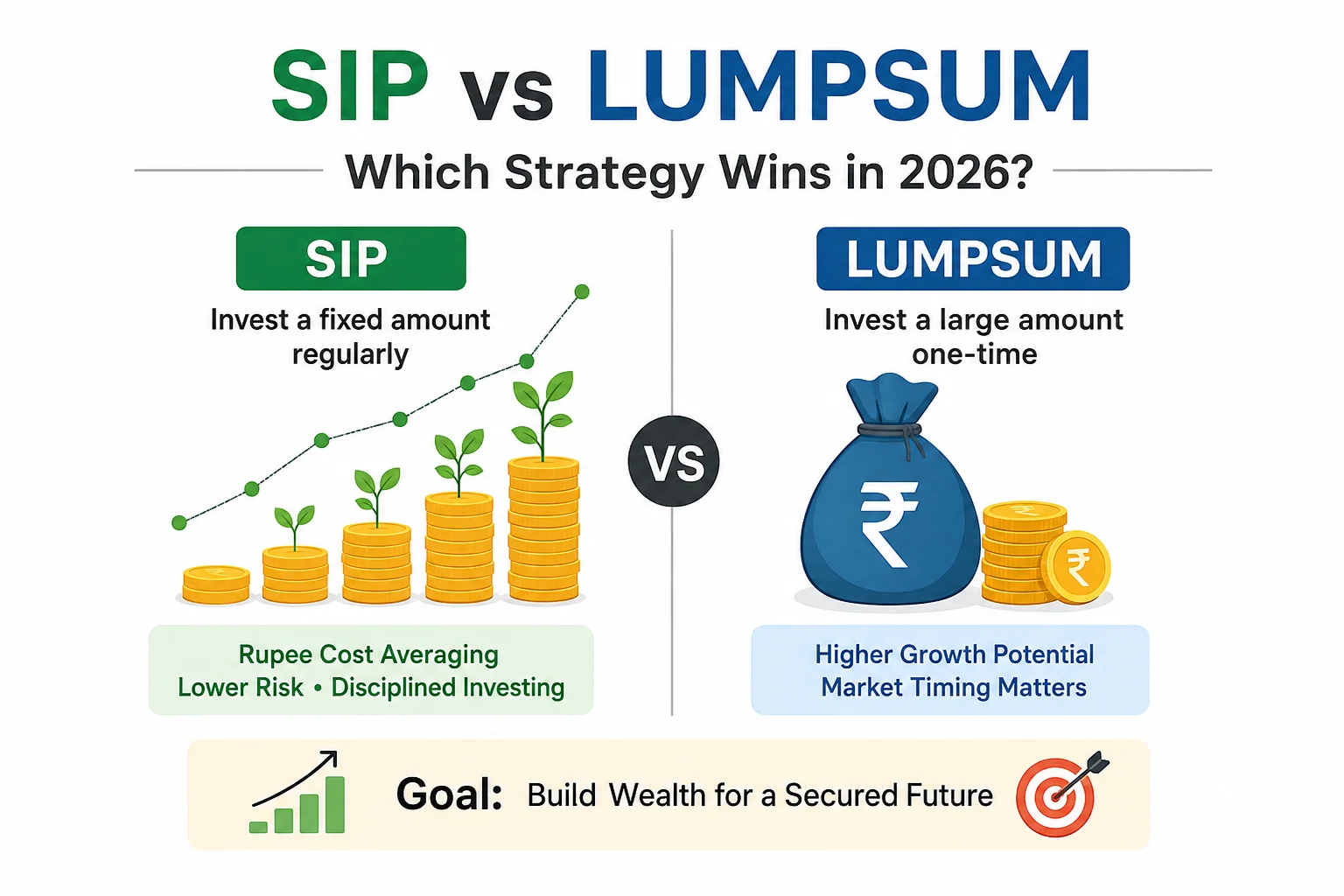
When planning your wealth creation journey, choosing between a SIP vs lumpsum investment India is one of the most critical decisions you will make. Suppose you have a total sum of ₹12,00,000 to invest in a mutual fund with an expected 12% CAGR. If you invest this entire ₹12,00,000 as a lumpsum on day one, your investment grows to ₹13,44,000 by the end of Year 1, and compounding this balance for another 10 years yields a final corpus of ₹41,74,260.
Alternatively, if you split it into a monthly Systematic Investment Plan (SIP) of ₹1,00,000 per month over 12 months, the future value at Month 12 is ₹12,80,933 (assuming standard monthly compounding at 1% per month), which compounds over the subsequent 10 years to reach ₹39,78,383. This leaves the lumpsum strategy with a clear ₹1,95,877 lead simply because the entire capital was working for the full duration, illustrating the primary trade-off of average time in the market versus risk reduction.
Table of Contents
1. What is SIP? A Quick Refresher
A Systematic Investment Plan (SIP) is a structured pathway offered by mutual funds that allows you to invest a fixed sum of money at regular intervals—usually monthly or weekly—rather than making a one-time payment. A core highlight of this strategy is that it automates your savings, transforming investing from a discretionary choice into a disciplined habit.
One of the primary mutual fund SIP benefits is that it eliminates the emotional stress of trying to time the stock market. Because you invest the same amount every month regardless of market movements, you automatically purchase more mutual fund units when prices are depressed and fewer units when prices are elevated. This mechanical adjustment is driven by the power of compounding and ensures that your portfolio stays active through all phases of the economic cycle.
2. What is Lumpsum Investment?
A lumpsum investment involves deploying a large amount of capital into a mutual fund or other financial instrument in a single transaction. This strategy is popular among investors who receive sudden windfalls such as yearly bonuses, property sale proceeds, business payouts, or mature insurance policies.
This method works best when you have idle capital that you want to put to work immediately to avoid inflation erosion. However, deploying a large sum into equity markets exposes you to significant volatility if the market is at a peak. If equity valuations appear overstretched, risk-averse investors might opt to park their money in risk-free options like fixed deposits instead. You can model guaranteed interest payouts using our free FD Calculator.
When dealing with equities, the primary drawback is the substantial lumpsum investment risk India investors face during periods of market volatility. If the market undergoes a correction shortly after you invest, your entire portfolio value will drop, which can trigger panic selling if you do not have a long investment horizon.
3. The Core Difference: Rupee Cost Averaging vs timing the Market
The fundamental difference between these two strategies lies in how they navigate market volatility. A lumpsum investor tries to time the market to buy when prices are low, which is extremely difficult. In contrast, a SIP investor relies on rupee cost averaging explained simply as a mechanical way to lower the average cost of buying fund units over time.
Let us look at a simplified example showing how a monthly SIP averages your purchase cost when the Net Asset Value (NAV) of a fund fluctuates over a 6-month period:
| Month | NAV (₹) | SIP Amount (₹) | Units Bought |
|---|---|---|---|
| Month 1 | ₹100 | ₹10,000 | 100.00 |
| Month 2 | ₹90 | ₹10,000 | 111.11 |
| Month 3 | ₹95 | ₹10,000 | 105.26 |
| Month 4 | ₹110 | ₹10,000 | 90.91 |
| Month 5 | ₹120 | ₹10,000 | 83.33 |
| Month 6 | ₹105 | ₹10,000 | 95.24 |
| Total: | ₹60,000 | 585.85 Units | |
If you look at the table, you can see that the investor deployed ₹60,000 in total and accumulated 585.85 units. The average purchase price per unit is calculated as: ₹60,000 / 585.85 = ₹102.41. If the investor had instead put a lumpsum of ₹60,000 in Month 5 when NAV was at its peak (₹120), they would have acquired only 500.00 units. By breaking down the deployment into monthly sums, the SIP investor acquired 85.85 more units.
This demonstrates how SIP naturally cushions your capital from buying at market peaks. Since timing the market is practically impossible for retail investors, a SIP ensures that you do not buy all your units at the worst possible price.
4. SIP vs Lumpsum Investment India: Returns Across Market Conditions
Which strategy wins under different economic scenarios? We ran a detailed SIP vs lumpsum returns comparison to evaluate how each strategy performs with a total investment of ₹1,20,000 over a 3-year period:
| Market Scenario | SIP Returns (est. ₹) | Lumpsum Returns (est. ₹) | Winner |
|---|---|---|---|
| Bull Market (rises steadily 15%/yr) | ₹1,52,260 | ₹1,82,505 | Lumpsum |
| Bear-then-Bull (falls 20%, then recovers) | ₹1,55,000 | ₹1,44,000 | SIP |
| Sideways Volatile Market (sideways churn) | ₹1,32,000 | ₹1,20,000 | SIP |
| Steady 12% CAGR Market | ₹1,43,584 | ₹1,68,591 | Lumpsum (Slight) |
5. Real Historical Example: Nifty 50 Comparison (2014-2024)
To understand these strategies, let us look at a real historical study of the Indian market. Suppose two investors started investing in a Nifty 50 index fund from January 2014 to December 2023 (a 10-year period):
- SIP Investor: Put ₹5,000 per month into the fund. Total invested over 10 years was ₹6,00,000. At an average CAGR of 12.5%, their final portfolio value reached approximately ₹11,62,000.
- Lumpsum Investor: Invested ₹6,00,000 as a single payment in January 2014. In 2014, the Nifty index was trading around 6,300. By December 2023, the index had crossed 21,700, representing a growth of roughly 3.44 times. Their final portfolio value grew to approximately ₹20,64,000 (representing an annual CAGR of 13.1%).
Why did the lumpsum investor win by such a wide margin here? The answer lies in the decade-long bull run of the Indian economy. Since the market grew steadily from 6,300 to 21,700, the lumpsum investor's entire capital was compounding at the index growth rate for all 10 years. In contrast, the SIP investor was slowly deploying capital, which meant their later installments had less time to compound.
However, this historical window highlights the benefits of rupee cost averaging explained. During the sudden 2020 stock market crash, the lumpsum investor saw their portfolio value drop by nearly 30% in a single month, which can cause significant stress. In contrast, the SIP investor continued to invest ₹5,000 monthly, buying index fund units at highly depressed NAVs. When the market recovered, those cheap units surged, cushioning the portfolio from losses.
6. When SIP is the Clear Winner
A Systematic Investment Plan is not just a math calculation; it is a behavioral tool. A SIP is the optimal strategy in these scenarios:
- Salaried Income: If you receive a monthly salary and do not have a large reserve of idle cash, a SIP is the only practical way to build wealth.
- Volatile Markets: When stock valuations are high and markets are moving sideways, a SIP protects your capital by averaging your purchase cost.
- First-Time Investors: If you are new to mutual funds, starting with a SIP helps you understand market volatility without risking a large sum of money.
- Emotional Discipline: A SIP automates the process, helping you avoid the temptation to stop investing during market corrections.
- Habit Building: Regular monthly debits build a savings discipline that helps you reach long-term goals like retirement.
7. When Lumpsum is the Clear Winner
While SIPs are popular, there are specific situations where a lumpsum investment is mathematically and practically superior:
- Post-Correction Valuations: When equity markets undergo a correction of 20% or more, deploying a lumpsum allows you to buy quality assets at cheap valuations.
- Windfalls and Maturing Deposits: If you receive a bonus or a fixed deposit matures, leaving that cash idle in a savings account earning 3% will destroy its value.
- Investing in Debt Funds: Since debt mutual funds have lower volatility, investing a lumpsum is highly effective compared to equity investments.
- Short Investment Horizon: If you are investing in liquid or ultra-short-term debt funds for a period of 6 to 12 months, volatility risk is minimal, making a lumpsum suitable.
- Experienced Investors: If you understand market cycles and valuations, you can time your entry to maximize returns.
8. The Best of Both: Systematic Transfer Plan (STP)
If you have a large sum of money to invest but are worried about market volatility, you do not have to choose between a SIP and a lumpsum. You can use a Systematic Transfer Plan (STP) to get the benefits of both.
An STP works by parking your lumpsum in a low-risk liquid or debt fund. From there, you set up an automatic transfer of a fixed amount every month into an equity fund of your choice.
Worked Example: If you have ₹10,00,000 to invest, instead of deploying it all at once or keeping it in a low-yield savings account:
- You invest the ₹10,00,000 as a lumpsum into a liquid fund earning a stable 6% p.a.
- You set up an STP to transfer ₹50,000 on the 5th of every month into an equity mutual fund.
- Every month, your liquid fund balance earns interest, while ₹50,000 is systematically moved to the equity fund, averaging your purchase cost over 20 months.
This strategy ensures that your idle money earns a return while you benefit from rupee cost averaging in the equity market, offering a balanced risk-return profile.
9. Quick Decision Framework
To choose the best investment strategy India 2026 offers for your needs, run your situation through this simple decision framework:
- Regular salary + no large savings → Start a monthly SIP.
- Large lump sum + market has corrected 15-20% → Deploy a lumpsum.
- Large lump sum + market at all-time high → Start an STP from a liquid fund.
- Long-term horizon (10+ years) → Both work, but a SIP builds a strong financial discipline.
10. Frequently Asked Questions: SIP vs Lumpsum
Which is better, SIP or lumpsum in mutual funds?
Neither strategy is universally better; it depends on your cash flow and market conditions. A lumpsum strategy generates higher returns in a rising bull market, while a SIP is superior in volatile or falling markets because it uses rupee cost averaging to buy cheap units. For most salaried investors, a SIP is the preferred choice as it aligns with monthly income.
Can I do both SIP and lumpsum in the same fund?
Yes, you can do both SIP and lumpsum investments in the same mutual fund scheme. You can set up a regular monthly SIP to maintain a disciplined savings habit and invest additional lumpsum amounts whenever you have extra cash or when the market undergoes a correction.
Is it good to invest lumpsum when market is down?
Yes, investing a lumpsum when the market is down is generally an excellent strategy. Doing so allows you to acquire mutual fund units at lower NAVs, which can boost your long-term returns when the market recovers. However, you should ensure that you are investing money that you do not need for the next 3 to 5 years.
What is the minimum amount for SIP in India?
The minimum monthly SIP amount in India is typically ₹500 for most mutual fund schemes, though some funds allow investments starting at ₹100 per month. This low entry barrier makes mutual funds accessible to almost everyone.
Does SIP always give better returns than lumpsum?
No, a SIP does not always give better returns than a lumpsum. In a steady bull market, a lumpsum investment will outperform a SIP because the entire capital compounds for a longer duration. A SIP is designed to manage risk and average your purchase cost, not necessarily to beat a lumpsum in all market conditions.
11. Conclusion
In conclusion, deciding on a SIP vs lumpsum investment India strategy comes down to your financial circumstances and market outlook. A lumpsum strategy allows you to capitalize on market corrections, while a SIP offers the benefits of rupee cost averaging and disciplined habit building. By combining both approaches, you can build a resilient portfolio that grows your wealth over time.