
PAN & TDS Rules 2026: Avoid 20% Higher Tax Deduction
Reviewed by MoneyUtility Team – Tax Compliance Desk
Senior Tax Advisor & Compliance Specialist | Anchor: FY 2025-26 (AY 2026-27)
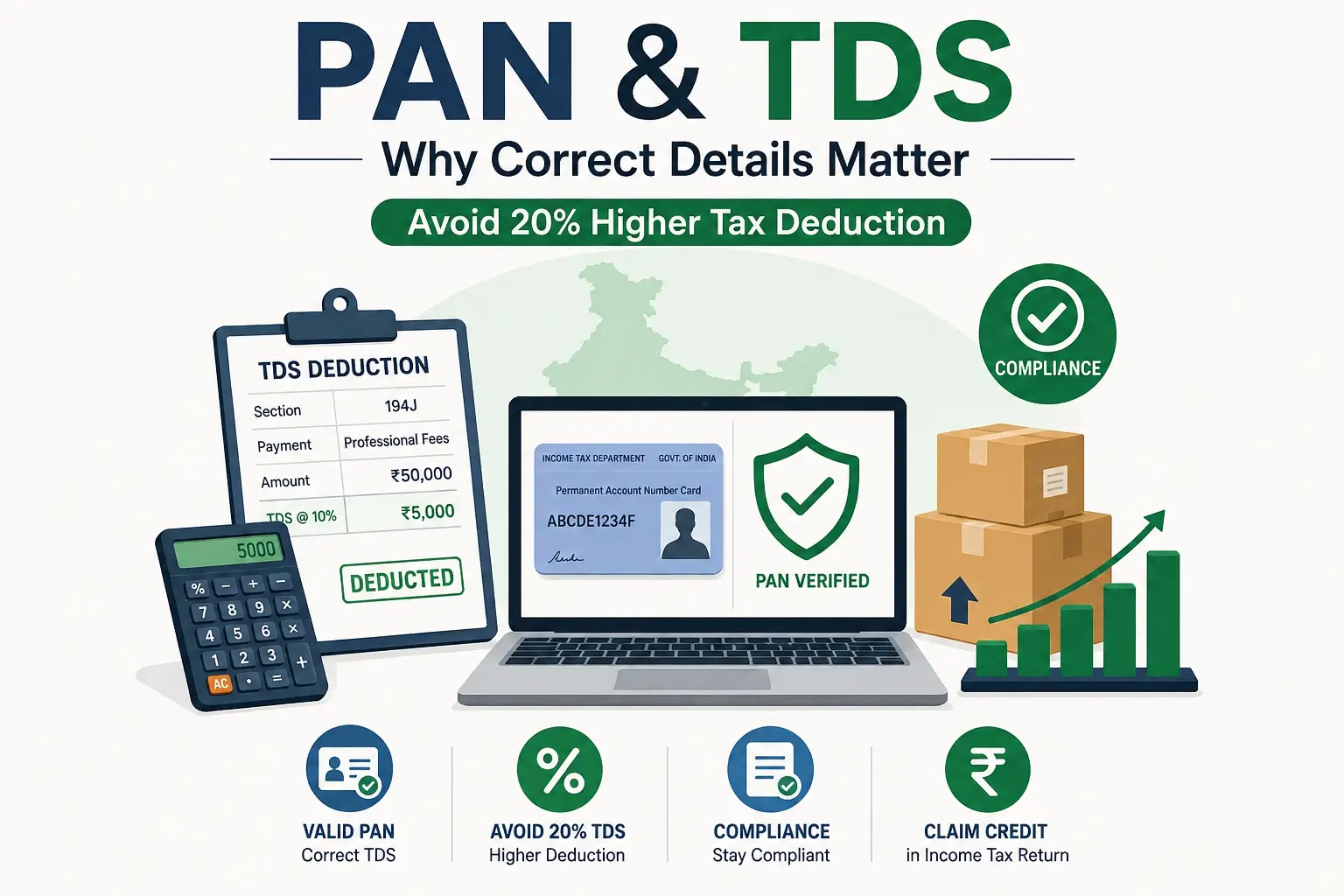
In Indian taxation, TDS (Tax Deducted at Source) serves as the Income Tax Department’s primary mechanism to collect taxes at the very point of income generation. Whether you are receiving a monthly salary, interest from fixed deposits, professional fees, or rental payments, deductors are legally required to withhold tax before making payments to you.
However, the entire TDS ecosystem relies on a single crucial key: your 10-digit alphanumeric Permanent Account Number (PAN). Failing to provide a valid, operative PAN to your deductor can result in a harsh tax penalty—withholding tax at a mandatory minimum rate of 20% under Section 206AA. For Income Tax filing in FY 2025-26 (AY 2026-27), ensuring your PAN details are completely accurate and active is essential to safeguard your monthly cash flows.
Section 206AA: Mandatory 20% Higher TDS Rate for Missing PAN
Section 206AA of the Income Tax Act, 1961, was introduced specifically to eliminate tax evasion stemming from unidentified payees. Under this statutory mandate, if any person receiving income liable to TDS fails to furnish their valid PAN to the deductor, tax must be deducted at the highest of the following rates:
- At the rate specified in the relevant provision of the Income Tax Act.
- At the rate or rates in force (as per the Finance Act for the relevant financial year).
- At the flat rate of 20%.
This means that even if a payment normally attracts a low TDS rate of 1%, 2%, 5%, or 10%, missing PAN details immediately escalate the withholding tax rate to 20%.
Inoperative PAN (Unlinked PAN-Aadhaar): Treated as "PAN Not Furnished"
A major area of confusion for taxpayers in FY 2025-26 relates to unlinked PAN-Aadhaar records. Under Rule 114AAA of the Income Tax Rules and CBDT Circular guidelines, if a taxpayer fails to link their PAN with Aadhaar within the prescribed statutory timeframe, their PAN becomes inoperative.
CBDT Legal Rule on Inoperative PAN
Legally, an inoperative PAN is treated as if PAN was never furnished. Deductors inspecting an inoperative PAN on the Income Tax Portal are legally mandated to deduct TDS at the penal 20% rate under Section 206AA. You can verify your status via the official portal or our TDS calculator & tax deduction checker.
Additionally, having an inoperative PAN triggers severe cascading compliance penalties:
- No tax refunds will be issued by the Income Tax Department while the PAN remains inoperative.
- No interest is payable on pending refunds for the period during which PAN was inoperative.
- TCS (Tax Collected at Source) is collected at higher rates under Section 206CC.
- Form 26AS and Annual Information Statement (AIS) entries will experience processing blockages.
Section 206AB: Higher TDS for ITR Non-Filers (Separate Trigger from Missing PAN)
While Section 206AA deals with missing or inoperative PANs, Section 206AB is an entirely distinct anti-evasion provision targeting non-filers of Income Tax Returns.
Section 206AB applies to a "Specified Person" who satisfies both of the following conditions:
ITR Non-Filing History
The payee has not filed their ITR for the preceding assessment year for which the due date under Section 139(1) has expired.
High Tax Withholding
The aggregate TDS and TCS in their case was ₹50,000 or more in that preceding financial year.
For a Specified Person under Section 206AB, TDS is deducted at the higher of:
- Twice the rate specified in the relevant provision of the Act; or
- 5%.
Interplay between 206AA and 206AB: If a payee has not furnished a PAN and is also an ITR non-filer under Section 206AB, Section 206AB(2) dictates that TDS will be deducted at the higher of the two rates computed under Section 206AA and Section 206AB.
TDS Rate Comparison Table by Common Sections for FY 2025-26 (AY 2026-27)
The table below compares standard TDS rates against the penal rate mandated under Section 206AA when a valid PAN is missing or inoperative. For an end-to-end breakdown of withholding thresholds and compliance schedules, see our guide on TDS basics in India.
| Section | Nature of Payment | Threshold Limit (₹) | Normal Rate (Valid PAN) | Missing PAN Rate (Sec 206AA) |
|---|---|---|---|---|
| 192 | Salary Payments | Basic Exemption Limit | Average Slab Rate | Slab Rate or 20% (whichever is higher) |
| 194A | Interest other than Securities (FDs, Savings) | ₹40,000 (₹50,000 for Senior Citizens) | 10% | 20% |
| 194C | Contractor / Sub-Contractor Payments | ₹30,000 single / ₹1,00,000 aggregate | 1% (Ind/HUF) / 2% (Others) | 20% |
| 194H | Commission or Brokerage | ₹15,000 | 5% | 20% |
| 194-I | Rent (Plant/Machinery vs Land/Building) | ₹2,40,000 per annum | 2% (Plant) / 10% (Building) | 20% |
| 194J | Professional & Technical Fees | ₹30,000 | 2% (Technical) / 10% (Prof.) | 20% |
Worked Numeric Example: TDS on ₹50,000 Professional Fees
To illustrate the real-world financial impact of missing PAN details, consider a freelancer receiving a payment of ₹50,000 for professional services under Section 194J during FY 2025-26:
Scenario A: Valid & Operative PAN
- Gross Fee Amount:
- ₹50,000
- Standard 194J TDS Rate:
- 10%
- TDS Amount Withheld:
- ₹5,000
- Net Bank Credit:
- ₹45,000
Scenario B: Missing / Inoperative PAN
- Gross Fee Amount:
- ₹50,000
- Section 206AA Penal Rate:
- 20%
- TDS Amount Withheld:
- ₹10,000
- Net Bank Credit:
- ₹40,000
Common PAN & TDS Compliance Mistakes to Avoid
To maintain seamless tax compliance and ensure tax credits are accurately reflected in your Form 26AS, avoid these common traps:
- Name Mismatch: Ensure the name spelling on your invoice or bank account matches your PAN card records exactly.
- Delaying PAN-Aadhaar Linking: Regularly check your linking status to avoid sudden PAN inoperation.
- Typographical Errors: Double-check the 10-character alphanumeric PAN string before submitting Form 15G/15H or invoice declarations.
- Ignoring Section 206AB Non-Filer Checks: Deductors should verify payee status using the Income Tax Department's "Compliance Check for Section 206AB & 206CCA" tool.