
TDS Basics in India: A Practical Guide (FY 2025-26)
Reviewed by MoneyUtility Team – Tax Compliance Desk
Senior Tax Advisor & Compliance Specialist | Anchor: FY 2025-26 (AY 2026-27)
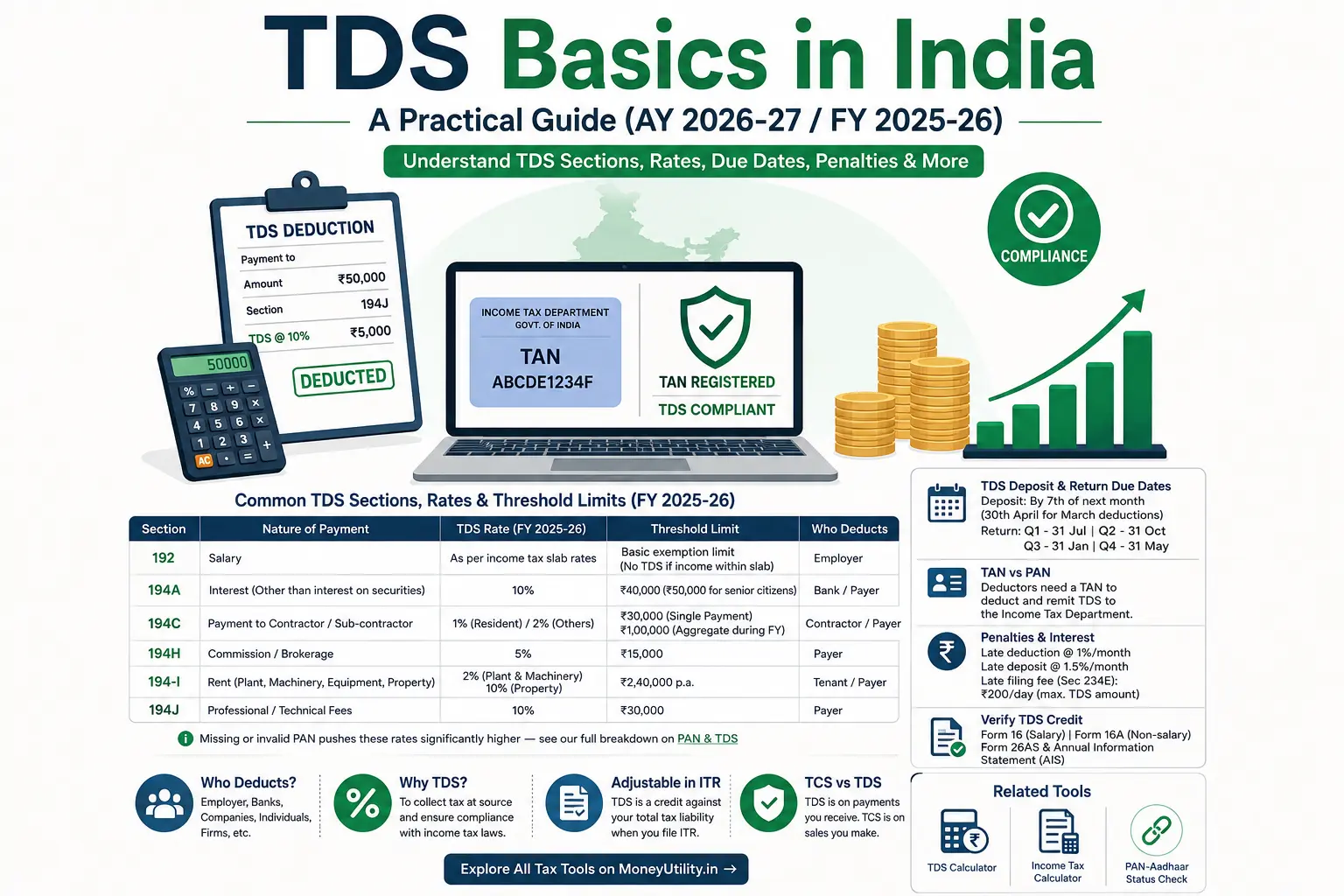
In the Indian tax structure, TDS (Tax Deducted at Source) is a key mechanism introduced by the Income Tax Department to collect tax directly at the origin of income. Under the provisions of the Income Tax Act, 1961, any entity or person making specified payments—such as salary, interest, commission, professional fees, or rent—is legally mandated to deduct a specific percentage of tax before remitting the net amount to the payee.
The primary objective of TDS is twofold: ensuring a steady, real-time revenue stream for the government throughout the financial year and maintaining a clear audit trail to curb tax evasion. For taxpayers and businesses navigating FY 2025-26 (AY 2026-27), understanding applicable TDS sections, exemption thresholds, deposit deadlines, and penalty structures is vital to maintain compliance and avoid costly interest charges. You can quickly calculate your tax liability under both old and new tax regimes using our Income Tax Calculator.
TDS vs TCS Distinction: While TDS (Tax Deducted at Source) is deducted by the payer from payments made to the payee (e.g. salary, rent, or professional fees), TCS (Tax Collected at Source) is collected by the seller from the buyer over and above the sale price on specific transactions (such as sale of luxury motor vehicles exceeding ₹10 lakh, foreign remittance under LRS, or scrap sales).
TAN vs PAN: Key Compliance Distinction
A common area of confusion among new business owners and taxpayers is the functional difference between TAN and PAN in the TDS process:
TAN (Tax Deduction Account Number)
A 10-digit alphanumeric code required by deductors (payers). Anyone required to deduct or collect tax at source must apply for TAN under Section 203A and quote it on all TDS challans, returns, and Form 16/16A certificates.
PAN (Permanent Account Number)
A 10-digit alphanumeric code issued to deductees (recipients of income). Payees must furnish their valid PAN to deductors to ensure TDS is withheld at standard rates and properly credited to their Form 26AS/AIS.
Note: Individuals making commercial payments above specified limits must obtain a TAN. However, for specific personal transactions—such as buying property over ₹50 lakh (Section 194-IA) or paying monthly rent above ₹50,000 (Section 194-IB)—individuals deduct TDS using their PAN without needing a TAN.
Common TDS Sections, Threshold Limits & Deduction Rates
Below is the comprehensive list of primary TDS sections under the Income Tax Act applicable for FY 2025-26 (AY 2026-27), along with their mandatory threshold limits and standard deduction rates:
Important Notice: Missing or invalid PAN pushes these rates significantly higher — see our full breakdown in our dedicated cluster guide on PAN & TDS Rules & Section 206AA Penalties. Under Section 206AA, non-furnishing of PAN triggers a mandatory 20% TDS rate, while Section 206AB imposes higher rates on specified non-filers.
| Section | Nature of Payment | Threshold Limit (FY 2025-26) | Standard TDS Rate |
|---|---|---|---|
| Section 192 | Salary Payments | Basic exemption slab limit (₹3,00,000 New Regime / ₹2,50,000 Old Regime) | Average Income Tax Rate |
| Section 194A | Interest on FDs & Securities (Banks / Post Office) | ₹40,000 p.a. (₹50,000 p.a. for Senior Citizens); ₹5,000 for non-banks | 10% |
| Section 194C | Payments to Contractors & Sub-contractors | Single payment > ₹30,000 OR Aggregate > ₹1,00,000 p.a. | 1% (Individual/HUF) | 2% (Company/Firm) |
| Section 194J | Professional, Technical & Royalty Fees | ₹30,000 per financial year (per category) | 2% (Technical services) | 10% (Professional fees) |
| Section 194H | Commission or Brokerage | ₹15,000 per financial year | 5% |
| Section 194-I | Rent on Land, Building, Furniture & Machinery | ₹2,40,000 per financial year | 2% (Machinery/Equipment) | 10% (Land/Building) |
TDS Deposit & Quarterly Return Due Dates
Compliance with TDS involves two distinct statutory deadlines: monthly tax deposit with the government treasury via Challan ITNS 281 and quarterly filing of TDS returns (Form 24Q for salary, Form 26Q for domestic non-salary payments).
Monthly TDS Deposit Schedule
- April to February deductions:7th of following month
- March deductions:30th April
Quarterly TDS Return Due Dates (FY 2025-26)
- Q1 (Apr 1 – Jun 30):31st July 2025
- Q2 (Jul 1 – Sep 30):31st October 2025
- Q3 (Oct 1 – Dec 31):31st January 2026
- Q4 (Jan 1 – Mar 31):31st May 2026
Penalties & Interest Charges for Non-Compliance
Delaying TDS deduction, remittance, or statement filing invites mandatory financial interest and late fees under the Income Tax Act:
Interest for Late Deduction of Tax
Calculated at 1% per month (or part of a month) from the date tax was deductible to the date tax is actually deducted.
Interest for Late Deposit of Tax
Calculated at 1.5% per month (or part of a month) from the date tax was deducted to the date tax is actually deposited in the government account.
Late Filing Fee for TDS Returns
Mandatory fee of ₹200 per day for every day of delay past the quarterly due date. The fee accumulates daily until filed, subject to a maximum cap equal to the total TDS amount due in that return.
Penalty for Non-Filing or Incorrect Statements
Assessing Officers can levy a penalty ranging from ₹10,000 to ₹1,00,000 if a TDS return is not submitted within 1 year from the due date or if incorrect PAN/financial details are filed.
How Deductees Can Verify TDS Credit
To claim credit for tax withheld when filing your Annual Income Tax Return (ITR), deductees should verify their tax deductions through the following official documents and portals:
Form 16
Annual TDS certificate issued by employers under Section 203 summarizing total salary paid, regime deductions, and tax deposited.
Form 16A
Quarterly certificate issued by non-salary deductors for payments under Section 194A (interest), 194J (professional fees), or 194C (contracts).
Form 26AS
Consolidated annual tax credit statement available on the TRACES e-filing portal linked directly with your PAN.
AIS & TIS
Annual Information Statement on the Income Tax portal offering real-time visibility into all financial transactions and TDS credits.