
Should You Prepay Your Personal Loan or Invest the Extra Money?
MoneyUtility Team
Personal Finance Expert
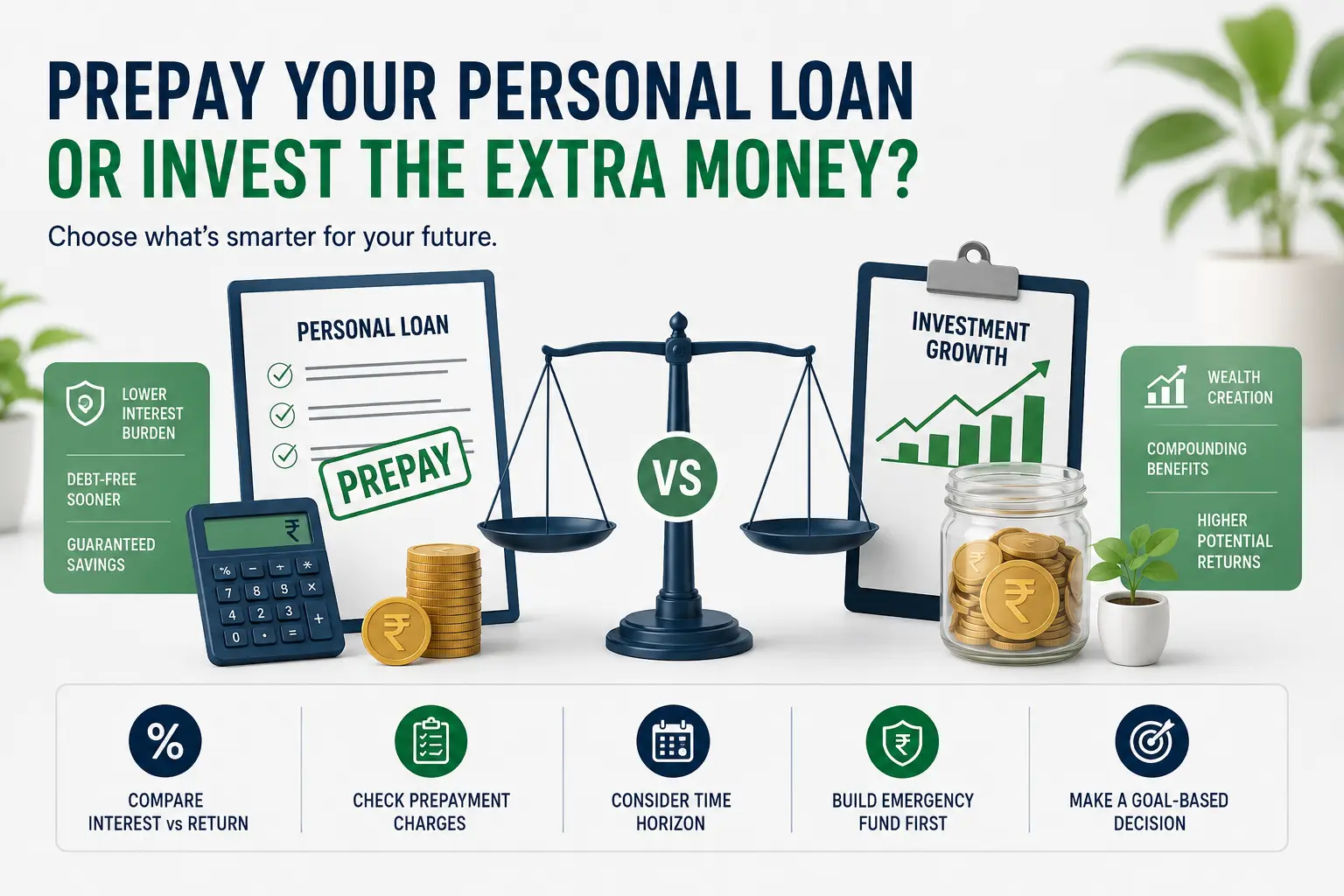
Receiving an annual performance bonus, an unexpected salary hike, or a lump sum gift feels like an immediate financial win. But for anyone carrying an active personal loan, that excitement is quickly followed by a tough decision: should you use the extra cash to prepay your loan principal, or should you put it into equity mutual funds, SIPs, or fixed deposits?
The debate comes down to a fundamental financial trade-off: guaranteed saving (prepay personal loan) versus uncertain but potentially higher market returns (investing). While financial influencers often advocate one extreme—either "be 100% debt-free" or "always invest for 15% CAGR"—the mathematically correct answer depends on your loan's net interest cost, tenure, prepayment penalties, and risk tolerance.
This guide delivers a practical decision framework designed for Indian borrowers. We break down effective loan interest costs, RBI rules on foreclosure charges, side-by-side mathematical worked examples, and clear guidelines on when prepaying beats investing.
Table of Contents
The Core Trade-off: Guaranteed Saving vs Market Return
When you prepay a personal loan, every rupee of principal you clear immediately eliminates future interest charges. Because this interest is money you would have definitely been forced to pay the bank, prepaying delivers a 100% risk-free, tax-free guaranteed return equal to your loan's effective interest rate.
Conversely, investing that extra money in mutual funds, stocks, or real estate carries market uncertainty. While equity investments in India have historically yielded strong long-term CAGR, short-to-medium term market returns can fluctuate widely. Furthermore, investment gains are subject to Capital Gains Tax (LTCG/STCG) and lack immediate liquidity if locked into debt instruments.
| Comparison Dimension | Prepay Personal Loan | Invest Extra Money (e.g. Equity SIP) |
|---|---|---|
| Return Guarantee | 100% Guaranteed (Equal to loan rate) | Uncertain (Depends on market performance) |
| Financial Risk | Zero risk | Moderate to High market volatility |
| Liquidity | Low (Money is locked in bank debt reduction) | High to Moderate (Can redeem open-ended funds) |
| Tax Treatment | Tax-free saving (No tax on interest avoided) | Taxable gains (LTCG / STCG applicable on profits) |
How to Calculate Your Loan's True Effective Interest Rate
To compare a loan against an investment fairly, you must evaluate the loan's true effective interest rate rather than just reading the headline rate in your sanction letter.
Unlike home loans, personal loans carry no tax deduction under Section 24(b) or 80C for salaried individuals (unless used strictly for tax-deductible business assets or home repairs). Therefore, your loan's stated interest rate is usually its net post-tax cost.
However, if your lender charges a foreclosure or partial prepayment penalty, that fee increases your hurdle rate. In plain language, your loan's effective interest cost can be estimated as:
Example Assumption: Suppose you have a personal loan at an assumed 13% per annum rate with 2 years remaining, and the bank charges a 2% foreclosure penalty on the balance. The total effective hurdle cost to clear that loan is roughly 13% + (2% ÷ 2) = 14% p.a.
It is also vital to understand how loan mechanics impact your savings. Understanding how loan tenure affects total interest shows that prepayments made during the early years of a tenure save far more interest than prepayments made near the end. Furthermore, ensure you are not confusing a reducing balance loan with a flat rate quote by checking whether your lender uses a flat vs reducing interest rate.
Prepayment Charges: What RBI Rules Say
Before making a prepayment or foreclosure, you must review the regulatory rules surrounding loan penalties in India.
As per Reserve Bank of India (RBI) guidelines on floating-rate loans, banks and Non-Banking Financial Companies (NBFCs) are strictly prohibited from charging foreclosure fees or prepayment penalties on floating-rate retail loans given to individual borrowers.
However, most personal loans in India are sanctioned as fixed-rate loans. For fixed-rate personal loans, RBI guidelines allow lenders to set their own prepayment rules. Consequently, standard commercial banks and digital NBFCs may charge anywhere from 2% to 5% plus GST on the prepaid amount or outstanding principal. Some lenders also enforce a minimum lock-in period (e.g. 6 to 12 months) before allowing partial or full prepayment.
When Prepayment Usually Wins (Worked Example)
Let's analyze a realistic scenario where prepaying the personal loan is the clear mathematical and financial winner.
Hypothetical Scenario:
- Lump sum available: ₹2,00,000 (from an annual bonus)
- Existing Personal Loan rate: 13.5% p.a. (reducing balance)
- Remaining Loan Tenure: 3 years (36 months)
- Alternative Investment Option: Balanced Hybrid Fund at an assumed 11% p.a. return (pre-tax)
- Prepayment Charge: Zero (assuming floating rate or fee-waived window)
To verify your exact monthly EMI and interest schedule, you can use the EMI calculator to test different prepayment amounts.
| Metric (3-Year Horizon) | Option A: Prepay Personal Loan | Option B: Invest in Mutual Fund |
|---|---|---|
| Capital Employed | ₹2,00,000 | ₹2,00,000 |
| Assumed Rate / Return | 13.5% p.a. interest saved | 11.0% p.a. growth (assumed) |
| Gross Monetary Benefit | ₹45,450 (Direct Interest Saved) | ₹33,526 (Pre-tax Investment Gain) |
| Tax Impact | ₹0 Tax (Savings are non-taxable) | ~₹4,190 (LTCG / Income Tax) |
| Net Wealth Impact | +₹45,450 Guaranteed | +₹29,336 (Non-guaranteed) |
Conclusion: In this case, prepaying the loan wins by over ₹16,000 in net benefit. When your personal loan interest rate (13.5%) clearly exceeds a realistic post-tax investment return (11% minus taxes = ~9.6%), prepayment is the mathematically superior and risk-free choice.
When Investing Usually Wins (Worked Example)
Now let's examine a scenario where investing the extra funds delivers superior long-term wealth creation.
Hypothetical Scenario:
- Lump sum available: ₹2,00,000
- Existing Loan rate: 8.5% p.a. (e.g. low-rate subsidized loan or home loan top-up)
- Investment Horizon: 7 years (long-term equity focus)
- Alternative Investment: Equity Index Fund at an assumed 13.5% p.a. CAGR return
Before committing your money, you can use the EMI calculator to compare the exact interest obligation over the remaining months.
| Metric (7-Year Horizon) | Option A: Prepay 8.5% Loan | Option B: Invest at Assumed 13.5% CAGR |
|---|---|---|
| Initial Amount | ₹2,00,000 | ₹2,00,000 |
| Total Interest Saved / Investment Growth | ~₹68,200 (Total interest saved over 7 yrs) | ~₹2,87,400 (Corpus value grows to ~₹4,87,400) |
| Estimated Post-Tax Gain | +₹68,200 Guaranteed | +₹2,44,000 (After LTCG allowance & tax) |
| Risk Factor | Zero Risk | Subject to Equity Market Risks |
Conclusion: When the borrowing cost is relatively low (8.5%) and the investment horizon is extended (7+ years), equity investing can build significantly greater long-term wealth. However, remember that equity market returns are never guaranteed, whereas loan interest savings are 100% locked in.
A Simple Decision Framework
Use this scannable ruleset to quickly evaluate your lump sum decision:
Emergency Fund First (Non-Negotiable Rule)
If you do not have 3 to 6 months of living expenses saved in a liquid bank account, do not prepay debt or invest in equities. Keep your lump sum in an emergency fund first.
Loan Rate > 12% p.a. → Lean Heavily Toward Prepayment
High-cost personal loans (12% to 18%+) are a financial drag. Clearing them yields a risk-free 12%+ guaranteed return that beats almost all risk-adjusted investments. If you also carry card balances, consult our guide on personal loan vs credit card debt payoff priority to eliminate toxic 40% interest first.
Loan Rate 8% – 12% p.a. → Evaluate Horizon & Hybrid Split
If your tenure is under 3 years, lean toward prepayment. If your horizon is 5+ years and you have strong risk tolerance, consider a 50/50 split between loan prepayment and equity SIPs using our SIP Calculator.
Loan Rate < 8% p.a. → Investing is More Attractive
For low-cost loans (e.g. tax-subsidized home loans or employer debt), investing in long-term equity index funds often generates superior net wealth. Borrowers can also explore restructuring personal loans via a Loan Against Property vs Personal Loan to reduce interest rates before deciding.
FAQs
Does RBI restrict prepayment penalties on personal loans?
Yes, as per RBI's guidelines on floating-rate loans, banks and NBFCs cannot levy foreclosure charges or prepayment penalties on floating-rate retail loans granted to individual borrowers. However, fixed-rate personal loans may still carry prepayment fees ranging from 2% to 5% plus GST depending on the lender's policy. Always check your specific loan agreement to verify.
Is a full foreclosure always better than a partial prepayment?
Not necessarily. Full foreclosure eliminates debt completely and saves maximum interest, but it requires a large cash outlay. A partial prepayment reduces your principal balance, lowering either your monthly EMI or remaining tenure, while allowing you to retain cash reserves for emergencies or other investments.
How do I compare a loan's interest rate with expected investment returns fairly?
To make a fair comparison, compare the net effective cost of the loan (interest rate plus prepayment charges minus any tax deductions) against the net expected return of the investment (nominal return minus capital gains tax and management fees). Always discount investment returns to reflect market risk.
Does prepaying a personal loan improve my CIBIL score?
Prepaying a personal loan lowers your total outstanding debt and reduces your Credit Utilization Ratio (CUR) across active accounts. While closing a loan early briefly reduces your credit mix diversity, consistent early payments and a lower debt burden generally strengthen your long-term CIBIL score.
What if my loan has no prepayment charge — does the decision change?
If there are zero prepayment charges, the threshold for prepaying becomes lower because 100% of your lump sum directly reduces principal. Prepayment becomes an even stronger default choice whenever your loan interest rate exceeds realistic post-tax investment returns.
Should I split the lump sum between prepayment and investing?
Yes, a hybrid approach is often optimal for risk balance. For instance, allocating 50% toward prepaying high-interest loan principal guarantees immediate interest savings, while directing the remaining 50% into equity SIPs or emergency liquid funds maintains long-term compounding potential and financial liquidity.
When deciding whether to prepay a personal loan or invest, never assume one choice is automatically correct for everyone. Compare your loan's real effective cost against a realistic, post-tax, risk-adjusted market return, confirm all foreclosure terms with your lender, and prioritize your emergency cash buffer above all else.
Calculate Your Exact EMI & Savings
Use MoneyUtility's free financial tools to calculate your loan EMI, amortization schedule, and expected mutual fund growth instantly.